

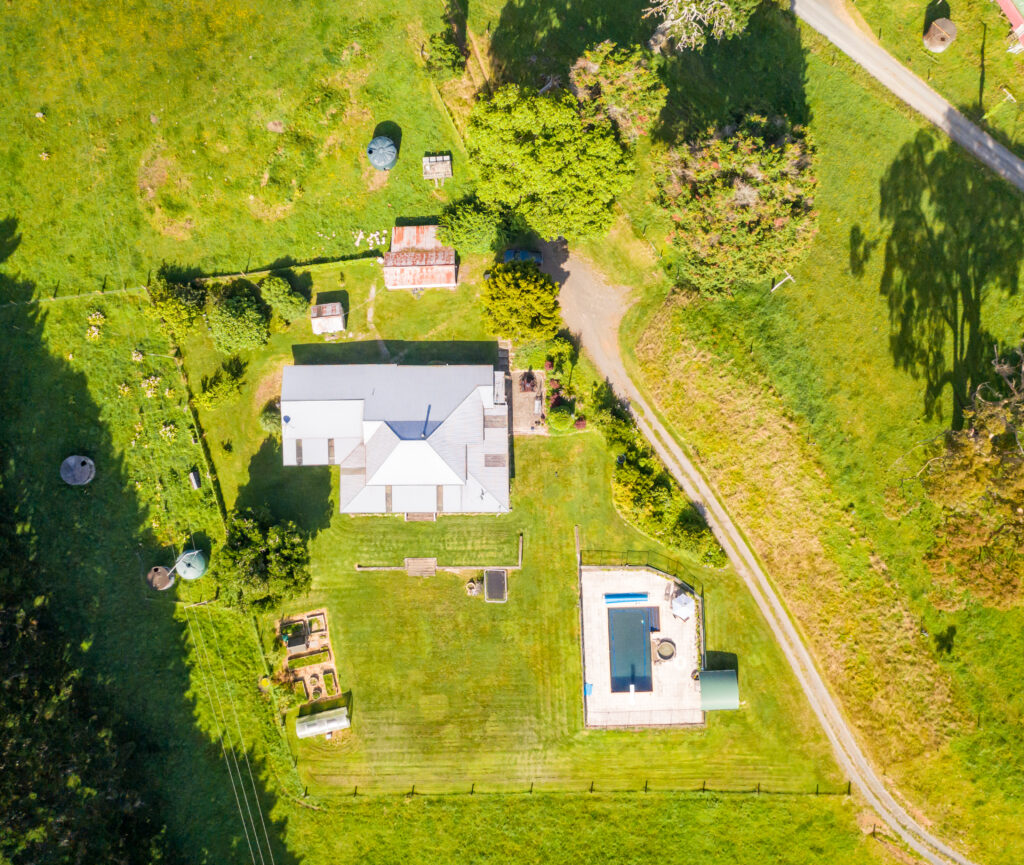
For nearly four decades, Ken Smith believed he was the undisputed owner of his rural home. His family had lived in the weatherboard cottage since the late 1940s, with cows grazing in nearby paddocks, fences erected and maintained, and a family sawmill operating just beyond. The lines on the ground seemed obvious. The lines on the land title eventually proved to be incorrect.
In 2022, the local council for Ravensdale, north of Sydney flagged the title issue to Smith’s neighbours — David and Carolyn Evans — who had purchased adjoining Lot 41 back in 1989.
The council – while preparing for nearby bridge upgrades and realignments – suggested that Smith’s house was actually sitting on part of Lot 41, not on his own land as everyone had assumed for decades.
The surprise discovery triggered a complicated legal dispute. Smith had no registered title to the land on which his house stood. The value of the occupied land gave rise to full-blown ownership battle way more serious than a neighbourly spat over fencing or boundaries.
The contest centred on the doctrine of adverse possession that allows – in some circumstances – someone to acquire ownership of land if they occupy it exclusively, openly, and continuously for long enough, usually at least 12 years.
Smith argued that his family’s occupation began no later than 1949, providing well over the required duration.
Well before the matter came before the court, the Evans’ conceded that Smith had gained adverse possession ownership of the land on which the house stood and some immediate land around it but fought against his claim to a much larger surrounding area.
Initially, the trial judge found in Smith’s favour, concluding that he had gained ownership of both the house and the substantial surrounding area on.
The New South Wales Court of Appeal scaled back that finding.
The appeal court accepted that Smith and his predecessors had possessed the house and its curtilage — the land directly associated with and necessary for the residential use of the home — but rejected the broader claim over the remaining “contentious land.”
The problem was simple: while there was good evidence of the Smiths using the house and nearby sheds, the court found little or no evidence of sustained use of the wider fenced land during the full period from 1949 to 1989. Occasional grazing of cows and horses wasn’t enough. Adverse possession requires – they explained – continuous, exclusive use, for which the evidence fell short.
Of great importance to Smith was his ability to drive to his front door via Ravensdale Road and a rough track crossing what’s known locally as the “unformed road” that passed close to the house as it made its way to the sawmill.
If the court had restricted Smith’s ownership to just the house footprint, he could have faced the absurd outcome of legally owning the home but having no right to access his own land by vehicle or on foot.
Fortunately for Smith, the appeal judges agreed that the curtilage should extend to include not only the area around the house but also the vehicle and pedestrian access route leading from his land to the unformed public road.
The judges recognized that denying access would defeat the very notion of residential occupation.
The finding that Smith’s practical use of the driveway and access track had long been part of his residential occupation allowed that to be added to the confines of the land awarded to him by reason of his :adverse possession”.
The remaining portions of Lot 41 stay with the Evans’.
As Smith himself remarked after the ruling, “It’s a strange thing when you need a court to tell you that your own driveway belongs to your own house — after you’ve lived there most of your life.”
Evans v Smith [2025] NSWCA 102 Ward P Stern JA and Adamson JA, 16 May 2025